
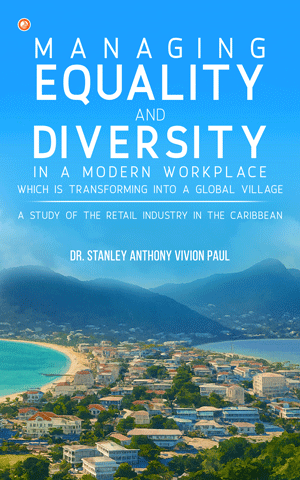
Managing Equality And Diversity In A Modern Workplace Which Is Transforming Into A Global Village

799.00


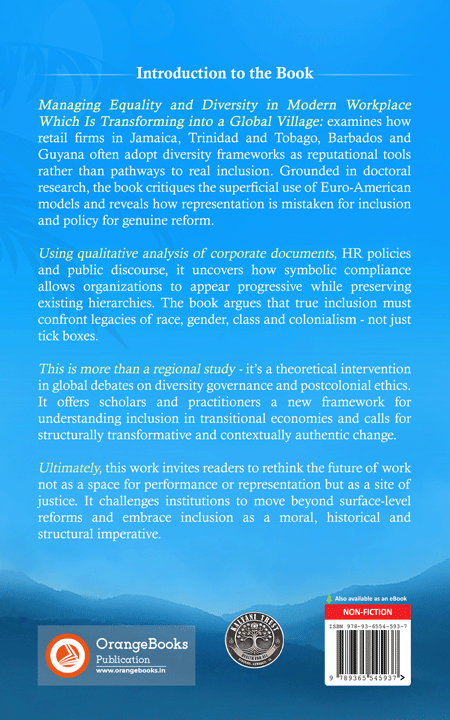
Back Cover

Managing Equality and Diversity in Modern Workplace Which Is Transforming into a Global Village: A Study of the Retail Industry in the Caribbean is an original and deeply incisive scholarly contribution to the fields of diversity governance, organizational legitimacy, and postcolonial management studies. Rooted in a rigorous doctoral investigation, this work interrogates the performative, symbolic, and often superficial modes through which diversity and inclusion (D&I) are governed within the Anglophone Caribbean’s retail sector, a vital but critically underexplored domain. At a time when global institutions tout D&I as essential for legitimacy, competitiveness, and justice, this book challenges the shallow mimicry of Euro-American diversity models in postcolonial societies. It demonstrates that in Jamaica, Trinidad and Tobago, Barbados, and Guyana, diversity frameworks are often adopted as reputational strategies rather than authentic tools for institutional transformation. Drawing on an interdisciplinary theoretical foundation, including intersectionality, institutional legitimacy theory, symbolic compliance, and postcolonial critique, the analysis reveals that many retail firms conflate representation with inclusion, policy with practice, and rhetoric with reform. This work transcends conventional “business case” justifications for diversity. It insists on a more historically grounded, structurally engaged, and critically reflexive approach, one that recognizes that true inclusion cannot be engineered through policy alone, but must dismantle entrenched hierarchies of race, gender, class, and colonial legacy. Employing a qualitative, desktop-based comparative methodology, the book meticulously analyzes corporate documents, HR policies, legal texts, and public discourse to reveal the gap between institutional discourse and organizational behavior. It highlights how symbolic compliance enables firms to signal progressive values while sustaining the status quo, thereby evading the redistributive and ethical commitments that genuine inclusion demands. This publication is more than a case study of the Caribbean, it is a theoretical intervention in global debates on organizational ethics and postcolonial modernity. It offers scholars, practitioners, and policymakers a new framework for understanding how inclusion is constructed, resisted, and negotiated within transitional economies shaped by historical injustice and institutional inertia. Ultimately, the book issues a call to action: for organizations to move beyond checkbox diversity and toward structurally transformative, contextually authentic, and ethically grounded inclusion. It is a must-read for those who seek to reimagine the future of work not merely as a space of efficiency or representation, but as a site of justice.

Description

Managing Equality and Diversity in Modern Workplace Which Is Transforming into a Global Village: A Study of the Retail Industry in the Caribbean is an original and deeply incisive scholarly contribution to the fields of diversity governance, organizational legitimacy, and postcolonial management studies. Rooted in a rigorous doctoral investigation, this work interrogates the performative, symbolic, and often superficial modes through which diversity and inclusion (D&I) are governed within the Anglophone Caribbean’s retail sector, a vital but critically underexplored domain. At a time when global institutions tout D&I as essential for legitimacy, competitiveness, and justice, this book challenges the shallow mimicry of Euro-American diversity models in postcolonial societies. It demonstrates that in Jamaica, Trinidad and Tobago, Barbados, and Guyana, diversity frameworks are often adopted as reputational strategies rather than authentic tools for institutional transformation. Drawing on an interdisciplinary theoretical foundation, including intersectionality, institutional legitimacy theory, symbolic compliance, and postcolonial critique, the analysis reveals that many retail firms conflate representation with inclusion, policy with practice, and rhetoric with reform. This work transcends conventional “business case” justifications for diversity. It insists on a more historically grounded, structurally engaged, and critically reflexive approach, one that recognizes that true inclusion cannot be engineered through policy alone, but must dismantle entrenched hierarchies of race, gender, class, and colonial legacy. Employing a qualitative, desktop-based comparative methodology, the book meticulously analyzes corporate documents, HR policies, legal texts, and public discourse to reveal the gap between institutional discourse and organizational behavior. It highlights how symbolic compliance enables firms to signal progressive values while sustaining the status quo, thereby evading the redistributive and ethical commitments that genuine inclusion demands. This publication is more than a case study of the Caribbean, it is a theoretical intervention in global debates on organizational ethics and postcolonial modernity. It offers scholars, practitioners, and policymakers a new framework for understanding how inclusion is constructed, resisted, and negotiated within transitional economies shaped by historical injustice and institutional inertia. Ultimately, the book issues a call to action: for organizations to move beyond checkbox diversity and toward structurally transformative, contextually authentic, and ethically grounded inclusion. It is a must-read for those who seek to reimagine the future of work not merely as a space of efficiency or representation, but as a site of justice.

Book Details

Available Format

Paperback Print

ISBN

9789365545937

Language

English

Page Count

300

Published Year

2025

Size

5×8 in

Author

Dr. Stanley Anthony Vivion Paul

Publisher

OrangeBooks Publication

Reviews

Reviews

There are no reviews yet.

Be the first to review “Managing Equality And Diversity In A Modern Workplace Which Is Transforming Into A Global Village”